Straddling the border between Central Java and East Java, Mount Lawu (3,265 metres) is one of the most rewarding — and most atmospheric — volcanoes you can climb in Indonesia. It is not the tallest peak on the island, nor the hardest, but few mountains in Java combine a proper summit sunrise, well-kept trails, ancient temples, and a living spiritual tradition quite like Lawu does. Pilgrims have walked these slopes for centuries, and today trekkers share the same stone steps, the same mountain huts, and the same dawn above the clouds.
This Mount Lawu trekking guide 2026 covers everything you need to plan the climb: the two classic routes from Cemoro Sewu and Cemoro Kandang, what the summit is really like, the temples and sacred sites along the way, where to stay, what it typically costs, and the safety basics that matter on a mountain that is friendly but still deserves respect.
Why Climb Mount Lawu?
Lawu sits on the border of Karanganyar Regency in Central Java and Magetan Regency in East Java, roughly between Solo (Surakarta) and Madiun. Its highest point, Hargo Dumilah, is the tallest peak in the immediate region, and on a clear morning the view stretches across a patchwork of Javanese farmland, distant volcanoes, and a sea of cloud filling the valleys below.
What sets Lawu apart is its character. The lower slopes are pine forest and tea-scented air around the hill town of Tawangmangu. Higher up, the trail passes savanna-like grassland, stone shelters, and small shrines where offerings are still left. The summit area itself is broad and relatively gentle, with several named peaks, a warung or two in season, and the famous stone structures that give the mountain its sacred reputation. For many Javanese, Lawu is a place of pilgrimage as much as a hiking destination, and that atmosphere — quiet, respectful, a little mysterious — is part of the experience.
Lawu is also a sensible choice for a first big Javanese volcano. The trails are well defined, the elevation gain is manageable over one long day or a relaxed overnight trip, and the base towns are easy to reach. If you have already climbed Merbabu or Merapi and want something with more cultural depth, Lawu is the natural next step.
When to Go: Best Season for Mount Lawu
The best time to climb Mount Lawu is during Java's dry season, typically from around April or May through to October. Trails are drier, the forest paths are less slippery, and your chances of a clear summit sunrise are much higher. June to September is generally the most reliable window, though weekends and public holidays can be busy on the Cemoro Sewu trail.
The wet season, roughly November to March, is still climbable, but expect mud, mist, leeches on the lower forest sections, and a much lower chance of a clear dawn. Rain can also make the stone steps slippery, so good footwear matters even more. If you can only travel in the wet season, build in a flexible day so you can pick the clearest morning, and check locally whether the trail is open — access is occasionally restricted during extreme weather or for conservation and ceremonial reasons.
Whenever you go, start early. Most trekkers begin in the late afternoon or evening for an overnight climb, or before dawn for a long day hike, so that they reach the summit for sunrise and descend before the afternoon cloud and rain build up.
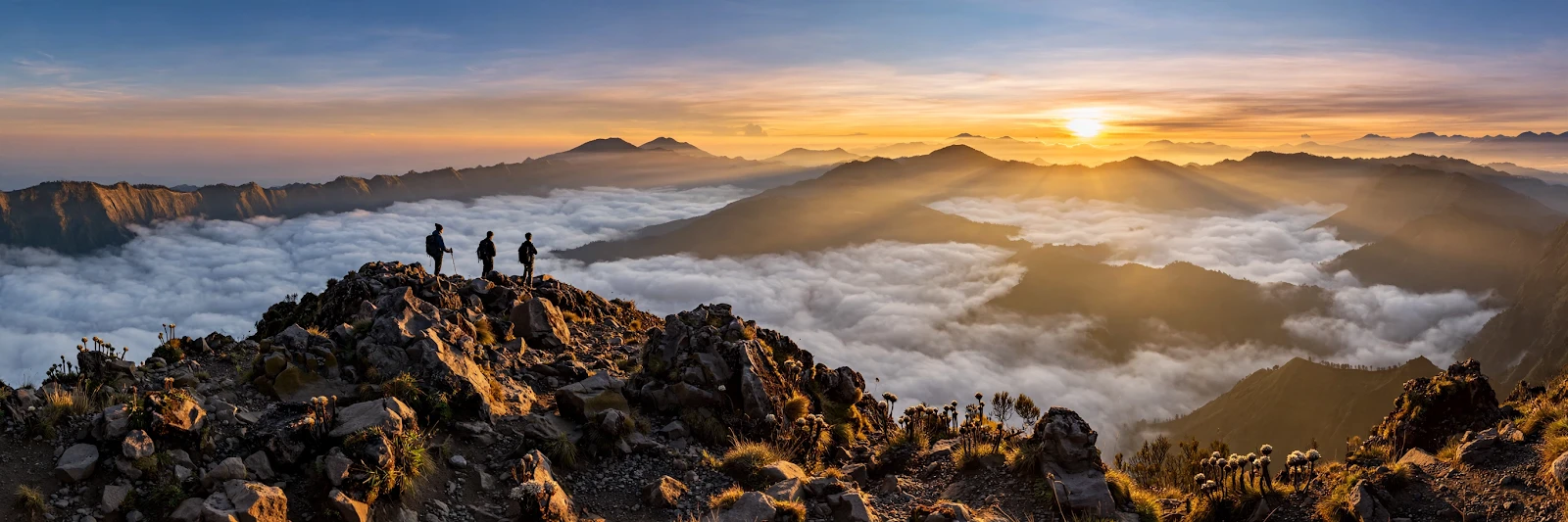
Sunrise above a sea of clouds from the summit of Mount Lawu.
The Cemoro Sewu Route: The Classic Climb
Cemoro Sewu, on the Central Java side near Tawangmangu, is the most popular and best-supported starting point for Mount Lawu. The basecamp sits at around 1,800 metres, so the climb to the 3,265-metre summit involves roughly 1,450 metres of ascent — a solid but very achievable day's walking, usually taking 5 to 7 hours up and 3 to 4 hours down, depending on your pace and how many breaks you take.
The trail is well marked and well trodden. It begins through pine forest on a mix of earth paths and long flights of stone steps — the steps that give this route its distinctive rhythm. There are a series of shelters, known locally as pos, spaced along the way, where you can rest, refill water in season, and buy snacks from small stalls when they are open. The middle section opens out into more exposed grassland, where the views back over Tawangmangu and the surrounding hills are superb on a clear day.
Higher up, the vegetation thins and the path crosses the broad, undulating summit plateau. This is where the mountain's sacred character becomes most visible: small shrines, stone structures, and quiet corners where pilgrims pause. The final push to Hargo Dumilah is gentle by volcano standards, which is part of why Cemoro Sewu suits first-time Lawu climbers and fitter families with older teenagers.
Because it is the classic route, Cemoro Sewu can feel sociable, especially on weekends. If you prefer a quieter trail, start on a weekday, or consider the Cemoro Kandang route below. Either way, register at the basecamp before you set off — registration is standard practice on Indonesian volcanoes, and the basecamp staff can also give you the latest trail and weather information.
Stone steps on the Cemoro Sewu trail, the classic route up Mount Lawu.
The Cemoro Kandang Route: The Quieter Alternative
Cemoro Kandang, on the East Java side near Magetan, is Lawu's other main trailhead and the quieter of the two classic routes. It is also a little longer and, in places, a little steeper, which is why many experienced local hikers prefer it: fewer crowds, a more forested feel, and a satisfying sense of arriving at the summit from a different direction.
The Cemoro Kandang trail climbs through dense forest before opening onto the same broad summit plateau as the Cemoro Sewu route, so both trails converge for the final section to Hargo Dumilah. Allow roughly 6 to 8 hours up and 4 to 5 hours down, and carry a little more water than you think you need, as resupply points are less frequent than on the Cemoro Sewu side. A headlamp is essential if you are walking in the dark, and a downloaded offline map is a useful backup, even though the trail itself is generally clear.
One popular option for confident hikers is to go up one route and down the other — for example, up Cemoro Sewu and down Cemoro Kandang, or the reverse. This gives you two different sides of the mountain in a single trip, but it requires transport arranged at both ends, so sort out your pickup or driver in advance rather than hoping for a ride at the trailhead.
Summit and Sunrise: What to Expect at the Top
Lawu's summit area is not a single sharp crater rim but a broad plateau with several high points, of which Hargo Dumilah (3,265 metres) is the highest. The atmosphere at dawn is unforgettable: if the weather cooperates, you will watch the sun rise over a sea of cloud, with the silhouettes of neighbouring volcanoes emerging as the light strengthens. It is cold up there before sunrise — layers, a windproof jacket, gloves, and a warm hat are not optional extras, even in the dry season.
Give yourself time at the top. The plateau rewards a slow wander: the stone structures, the views in every direction, and the simple pleasure of breakfast at altitude after a night climb. Small warungs near the summit area sometimes sell hot drinks and instant noodles in the busy season, but do not rely on them — carry your own food, water, and a warm drink if you can.
Descend carefully. Most accidents on Lawu, as on any mountain, happen on the way down, when legs are tired and stone steps are slippery with dew. Trekking poles help enormously, especially on the long stepped sections of the Cemoro Sewu route. Keep an eye on the time, too: aim to be well below the summit plateau before the afternoon weather turns.
Temples and Sacred Sites: Lawu's Spiritual Side
Mount Lawu has been a sacred mountain for centuries, and its slopes are dotted with temples and shrines that are still visited by pilgrims today. Two of the best known are on the lower western slopes near Tawangmangu: Candi Sukuh, a distinctive 15th-century temple with an unusual truncated-pyramid shape, and Candi Cetho, a beautifully sited hillside temple complex with terraces, stone gateways, and sweeping views over the plains below. Both are well worth a half-day visit before or after your climb, and they help explain why Lawu is spoken of with such reverence.
A small stone temple near Lawu's summit, part of the mountain's sacred character.
Higher on the mountain, the sacred character continues in smaller, quieter forms: shrines, offering places, and stone structures near the summit that pilgrims visit, particularly around Javanese ceremonial dates such as 1 Suro (the Javanese New Year), when the mountain can be very busy with pilgrims. As a visitor, the etiquette is simple and universal: be quiet around shrines, do not touch or move offerings, ask before photographing people at prayer, and leave every site exactly as you found it.
This spiritual dimension is one of the reasons Lawu feels different from a purely physical climb. You are walking a route that has meant something to people for a very long time. Treating it with that respect costs nothing and adds a great deal to the experience.
Where to Stay: Tawangmangu, Sarangan, and Magetan
Most Cemoro Sewu climbers base themselves in Tawangmangu, a cool hill town about 30 to 45 minutes below the trailhead, with a good range of guesthouses, small hotels, and homestays. It is also a pleasant place to recover after the climb, with waterfalls nearby — including the popular Grojogan Sewu waterfall — and fresh mountain air that feels like a reward in itself.
If you are climbing from Cemoro Kandang, look at accommodation around Sarangan Lake or in Magetan town on the East Java side. Sarangan, a lakeside resort town, is a charming base with restaurants and boat rides on the lake, and it makes a good overnight stop either before or after the hike. Solo (Surakarta) is the most convenient larger city for the Central Java side, with an airport, train station, and a wide choice of hotels, while Madiun serves the same role for the East Java side.
Book ahead on weekends and public holidays, when both trailheads and the base towns fill up. On weekdays in the low season, you can usually find a room on arrival, but a confirmed booking removes one worry from a trip that already involves an early start.
Costs and Practical Tips
Mount Lawu is an affordable climb by international standards, but prices change, so treat the figures below as typical ranges and check locally before you go. Basecamp registration and entrance fees for Indonesian volcanoes are usually modest — typically in the range of tens of thousands of rupiah per person for domestic visitors, with a higher rate for international visitors — and a local guide, if you hire one, is typically charged per day or per trip. Porters can also be arranged at the basecamp if you want help with heavy bags on an overnight trip.
Transport is the other main cost. From Solo, a car or taxi to Tawangmangu and Cemoro Sewu typically takes around one to two hours depending on traffic, and hiring a driver for the day is often the simplest option, especially if you need a very early or very late pickup. Public transport exists but is slower and less flexible for a dawn or overnight climb. If you traverse from one trailhead to the other, agree the pickup point, time, and price with your driver in advance.
Pack for a proper mountain day, not a walk in the park: sturdy hiking shoes with good grip, a headlamp with spare batteries, at least two litres of water per person plus snacks, a rain jacket, warm layers for the summit, sun protection, basic first aid, and a charged phone. Cash is useful at the basecamp and at mountain stalls, as card payments are not reliable on the trail. Finally, carry all your rubbish back down — Lawu's trails stay beautiful because hikers look after them.
Mount Lawu Itinerary Suggestions
One-Day Sunrise Hike (Fit Hikers)
Arrive at Cemoro Sewu basecamp in the late evening, register, and start walking around midnight. Reach the summit plateau for sunrise, enjoy an hour at the top, then descend the same route, arriving back at the basecamp in the late morning. This is a long, tiring day — roughly 9 to 11 hours of walking — so it suits fit, experienced hikers who are comfortable walking in the dark.
Relaxed Two-Day Trip (Recommended for Most Visitors)
Day 1: Arrive in Tawangmangu, visit Candi Sukuh or Candi Cetho in the afternoon, sleep early, and start the climb in the late afternoon or evening. Camp or rest at a shelter partway up, or push on to the summit area for a night at altitude. Day 2: Watch the sunrise from Hargo Dumilah, explore the summit plateau at a leisurely pace, descend to Cemoro Sewu, and recover in Tawangmangu with a waterfall visit or a long lunch. This is the version of the trip most first-time Lawu climbers enjoy most.
Temples and Mountain Long Weekend
Day 1: Solo or Tawangmangu arrival, Candi Sukuh and Candi Cetho. Day 2: Climb from Cemoro Sewu, summit sunrise, descend. Day 3: Sarangan Lake on the East Java side, or a slow morning in Tawangmangu before heading back to Solo. This longer version lets you see both the cultural and the mountain sides of Lawu without rushing either.
Safety on Mount Lawu
Lawu is a welcoming mountain, but it is still a 3,265-metre volcano, and the basics matter. Always register at the basecamp and tell someone your planned route and expected return time. Check the weather forecast and ask basecamp staff about trail conditions before you set off. Do not climb alone in the dark if you can avoid it — join other hikers or hire a local guide, particularly on the quieter Cemoro Kandang route.
Altitude affects people differently, and while Lawu's height is moderate, headaches, nausea, or unusual fatigue are signs to slow down, rest, and descend if they do not improve. Drink regularly, eat even when you do not feel hungry, and keep your phone charged for navigation and emergencies, but do not rely on mobile signal everywhere on the mountain. Finally, respect any closure notices: if the trail is closed for weather, conservation, or ceremony, that decision is made for good reason.
Sponsored: see today's best travel deals and offers
Frequently Asked Questions
How long does it take to climb Mount Lawu?
From Cemoro Sewu, most hikers take 5 to 7 hours up and 3 to 4 hours down. From Cemoro Kandang, allow 6 to 8 hours up and 4 to 5 hours down. Your time will depend on fitness, rest stops, and weather, so treat these as typical ranges rather than guarantees.
Is Mount Lawu suitable for beginners?
Yes, with preparation. Lawu is one of the more beginner-friendly major volcanoes in Java, thanks to its well-marked trails and gentle summit plateau. You should still be reasonably fit, wear proper hiking shoes, and ideally climb with a companion or guide. A two-day itinerary is a better choice for beginners than a single overnight push.
Which route is better, Cemoro Sewu or Cemoro Kandang?
Cemoro Sewu is the classic, better-supported route and the best choice for first-time visitors. Cemoro Kandang is quieter, a little longer, and slightly more demanding, making it a great choice for experienced hikers or anyone returning to Lawu for a different experience. Climbing up one route and down the other is a popular option if you can arrange transport at both ends.
Do I need a guide for Mount Lawu?
A guide is not always mandatory, but one is strongly recommended if you are new to Indonesian volcanoes, climbing in the dark, or taking the quieter Cemoro Kandang route. Local guides know the trail, the weather patterns, and the mountain's customs, and hiring one supports the communities around the trailheads. Register at the basecamp either way.
What should I pack for a Mount Lawu sunrise hike?
Sturdy hiking shoes, a headlamp, warm layers including a windproof jacket, gloves and a hat for the cold summit, a rain jacket, at least two litres of water, snacks, sun protection, basic first aid, and a charged phone. Cash is useful at the basecamp and mountain stalls. Pack light, but do not skip the warm layers — the summit before sunrise is cold at any time of year.
Mount Lawu rewards everyone who makes the effort: a sunrise above the clouds, temples that connect you to centuries of Javanese history, and a mountain that feels sacred without ever feeling unwelcoming. Plan around the dry season, pick the route that suits your experience, respect the mountain and its pilgrims, and give yourself time at the top to take it all in. Have you climbed Lawu, or are you planning your first trip? Share your route, your summit sunrise story, or your questions in the comments below — your experience could help the next hiker plan theirs.



Comments
Post a Comment