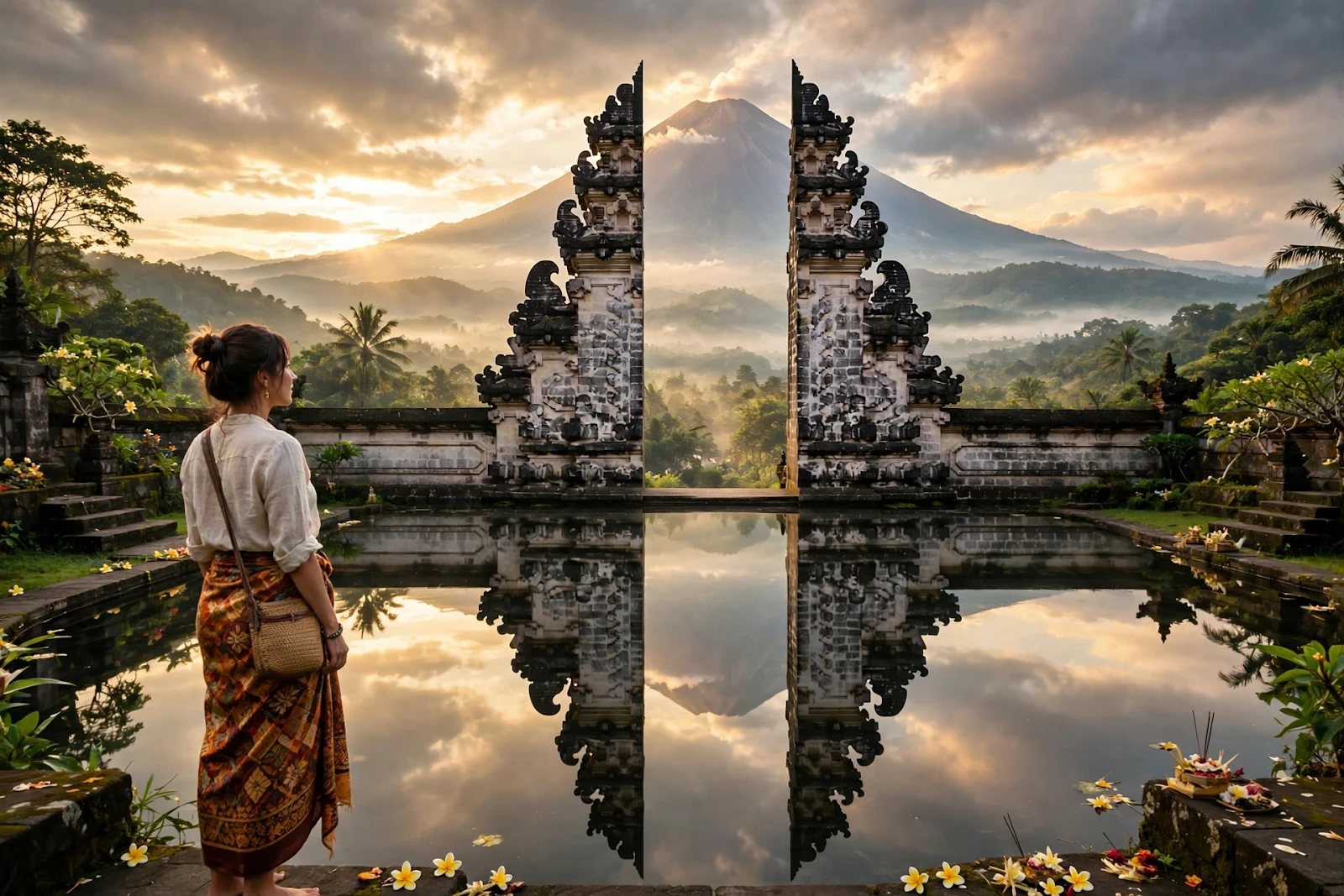
High on the forested slopes of Mount Lempuyang in East Bali stands one of the island's oldest and most sacred temples — and in front of it, a stone gate that has become one of the most photographed frames in all of Indonesia. The Gate of Heaven at Lempuyang Temple (Pura Lempuyang Luhur) perfectly frames the cone of Mount Agung, Bali's great volcano, and on a clear morning the view feels almost unreal: a doorway in the clouds, with the mountain floating behind it.
This Lempuyang Temple guide covers everything you need to plan a visit in 2026: how to get there, ticket prices, the dress code, the famous photo queue, the mirror trick everyone asks about, and how to combine the temple with the rest of East Bali in a single rewarding day. Come for the photo, but stay for the temple itself — it is a living place of worship, older and quieter than the crowds at its gate suggest.
The Gate of Heaven at Lempuyang Temple framing Mount Agung at sunrise — the shot that made East Bali famous.
Why Lempuyang Temple Is Worth the Early Start
Lempuyang Temple is one of Bali's six holiest temples (Sad Kahyangan) and is believed to predate most of the island's other great temples. The main shrine, Pura Lempuyang Luhur, sits at 1,058 metres above sea level, reached by a long climb of around 1,700 stone steps through jungle. Most visitors never climb that far — the famous gate belongs to Pura Penataran Agung, the lowest of the seven temples on the mountain, and that is where the crowds gather.
What makes the visit special is the combination: a genuinely sacred site, a dramatic mountain backdrop, and the cool, misty air of Bali's eastern highlands. On a clear morning, Mount Agung rises directly through the gate, and the whole scene glows gold. On a cloudy day, the mountain hides — and the gate is still beautiful, but the magic is gone. That is why timing matters so much here, and why this guide spends so much time on when to go.
How to Get to Lempuyang Temple
Lempuyang Temple sits in the far east of Bali, in Karangasem Regency, about a two-hour drive from Ubud and roughly two and a half hours from South Bali (Kuta, Seminyak, Canggu). There is no practical public transport, so almost everyone arrives by private car with a driver or on a rented scooter.
From Ubud, Candidasa and Amed
From Ubud, the drive takes around two hours via the eastern coastal road, passing through Klungkung and Candidasa. From Candidasa it is about 45 minutes, and from Amed — the laid-back diving town on the north-east coast — it is roughly 40 minutes, which makes Amed the best base if Lempuyang is your priority. From South Bali, leave by 4:00–4:30 AM if you want to reach the temple for the first light; the roads are quiet at that hour and the drive is straightforward.
Parking and the Shuttle
Private cars stop at a parking area partway up the mountain. From there, a temple shuttle runs visitors up the steep road to the temple entrance — walking the road is not permitted for visitors. The shuttle is included in the entrance ticket, and the ride takes only a few minutes. Scooters can park closer to the temple, but check the current rules at the gate, as arrangements change from time to time.
Tickets, Shuttle and Dress Code in 2026
Foreign visitors pay an entrance fee that covers the shuttle and a sarong rental — expect around IDR 100,000 per person, though prices are reviewed regularly and can change, so treat this as a guide rather than a guarantee. The ticket is bought at the entrance area, where staff will also help you with the sarong.
The dress code is strict, and it applies to everyone. You must wear a sarong and a sash (selendang) to enter the temple, and shoulders and knees should be covered — bring a T-shirt or a light cover-up rather than a tank top. Sarongs are provided with the ticket, but wearing your own is fine too. As at all Balinese temples, visitors are asked to respect the customs of a working place of worship: speak quietly, do not climb on the shrines, and follow the instructions of the temple staff and the pecalang (temple guards).
The Gate of Heaven Photo: Queues, the Mirror Trick and Realistic Expectations
Let us be honest: most people come to Lempuyang for one photograph. A numbered queue system manages the photo line at the gate, and your wait depends entirely on when you arrive. Arrive at opening and you may wait 30–60 minutes; arrive at 9:00 AM on a busy day and the wait can stretch to two or three hours. There is no shortcut — the queue is the queue, and everyone waits their turn.
When your number is called, you get a few minutes at the gate with the temple's own photographer. The famous "reflection" in the viral photos is not a lake: the photographer holds a small mirror under the phone lens to create the reflection effect. It is a clever trick, and it works beautifully — but it is worth knowing before you go, so the photo feels like a fun souvenir rather than a disappointment. You can also take your own photos from the side of the gate while you wait, and the wider temple courtyard is often quieter and just as photogenic.
Tips for the Best Photo
- Arrive early: be at the temple by 6:00–6:30 AM for the shortest queue and the best light.
- Watch the weather: Mount Agung only appears on clear mornings. Check the forecast the night before and be ready to swap your plans if clouds roll in.
- Wear something that pops: a bright dress or a flowing sarong photographs beautifully against the dark stone and green mountain.
- Bring small cash: the photo service has a modest fee, and tips for the photographer are appreciated.
- Be patient and polite: the staff manage hundreds of visitors a day; a smile goes a long way.
The moss-covered stone stairway climbing through the mist to the upper temples of Mount Lempuyang.
Beyond the Gate: The Seven Temples of Mount Lempuyang
Few visitors realise that the Gate of Heaven is only the first of seven temples strung along the mountain trail. The full pilgrimage climbs about 1,700 steps to Pura Lempuyang Luhur at the summit, passing shrines with names like Pura Telaga Mas, Pura Pasar Agung and Pura Luhur Lempuyang along the way. The climb takes around two to three hours up and is a proper hike — steep steps, jungle heat, and long stretches with no shops.
If you have the energy, the climb is a completely different experience from the photo queue: quiet forest, the sound of birds and insects, occasional monkeys, and small shrines where you will often be entirely alone. Bring water, wear proper shoes, and start early. Even climbing partway — to the second or third temple — gives you sweeping views across East Bali and the Lombok Strait. Most day-trippers skip this entirely, which is exactly why it is worth doing.
Best Time to Visit Lempuyang Temple
The best time to visit is during Bali's dry season, roughly April to October, when clear mornings are most likely and Mount Agung is most often visible. The wet season (November to March) brings dramatic clouds and lush green landscapes, but the mountain hides more often and rain can arrive without warning.
Time of day matters even more than the season. The first hour after opening offers the softest light, the clearest mountain views and the shortest queues. By mid-morning the haze builds, the light hardens, and the queue lengthens. Sunrise itself is best watched from the temple courtyard rather than through the gate, which faces east and catches the sun directly — photographers should expect strong backlight before about 7:00 AM and plan accordingly.
One-Day East Bali Itinerary: Lempuyang, Tirta Gangga and More
Lempuyang pairs naturally with the rest of East Bali, and a full-day loop from Ubud or Amed covers the region's highlights without rushing. Here is a route that works well:
- 4:30 AM — Leave Ubud or your hotel in Amed/Candidasa.
- 6:00–8:30 AM — Lempuyang Temple: the gate, the photo queue, and a short walk up the first stretch of steps.
- 9:00–10:30 AM — Tirta Gangga Water Palace, about 30 minutes away: a royal water garden of pools, fountains and koi, and one of Bali's most peaceful mornings.
- 11:00 AM–12:30 PM — Lunch in Candidasa, a quiet fishing town with good beachfront warungs and views across to the islands of Nusa Penida.
- 1:00–3:00 PM — Amed or the Virgin Beach (Pantai Pasir Putih) near Candidasa for a swim and a snorkel — the reef at Amed is excellent and the water is calm.
- 3:30 PM — Drive back, or stay the night in Amed and watch the sunset over the bay.
A quiet moment at the Lempuyang viewpoint — Mount Agung reflected in the temple's still water pool.
Practical Tips for a Smooth Visit
- Book a driver the day before: a full-day East Bali car with driver typically costs around IDR 500,000–700,000. Agree on the route and the start time in advance.
- Bring cash: the temple, small warungs and parking are cash-only. Small notes are useful.
- Pack light but smart: water, sunscreen, a hat, a light rain jacket in the wet season, and proper walking shoes if you plan to climb.
- Respect the temple: Lempuyang is an active place of worship. Keep your voice down, ask before photographing ceremonies, and never stand on the shrines or the gate itself.
- Have a plan B: if Mount Agung is hidden by cloud, enjoy the temple and head to Tirta Gangga — the water palace is beautiful in any weather.
- Stay nearby if you can: one night in Amed or Candidasa turns a long, early day into a relaxed East Bali weekend.
Sponsored: see today's best travel deals and offers
Frequently Asked Questions
How much does it cost to visit Lempuyang Temple in 2026?
Foreign visitors pay an entrance fee of around IDR 100,000 per person, which covers the shuttle from the parking area and a sarong rental. The photo service at the Gate of Heaven has a separate modest fee. Prices are reviewed regularly, so confirm the current rate when you arrive.
How long is the queue for the Gate of Heaven photo?
It depends on your arrival time. Early birds arriving at opening usually wait 30–60 minutes; by mid-morning on a busy day, the wait can reach two to three hours. Arriving before 6:30 AM is the single best way to keep the wait short.
Is the reflection in the Lempuyang photos real?
No — there is no lake in front of the gate. The temple photographer holds a small mirror under the camera lens to create the reflection effect. The mountain and the gate are real; the mirror simply adds the reflection you see in viral photos.
Can I climb to the top temple of Mount Lempuyang?
Yes. A trail of around 1,700 steps leads from the lower temple to Pura Lempuyang Luhur at the summit, passing six more temples on the way. Allow two to three hours for the climb, bring water and good shoes, and start early to avoid the midday heat.
What should I wear to Lempuyang Temple?
A sarong and sash are required for entry and are provided with your ticket. Cover your shoulders and knees, wear comfortable walking shoes, and bring a hat and sunscreen for the open courtyard areas.
Lempuyang Temple rewards the travellers who arrive early, look beyond the famous gate, and treat the mountain with respect. Whether you climb all 1,700 steps to the summit shrine or simply stand in the courtyard as the morning mist lifts off Mount Agung, it is one of those rare places in Bali that still feels sacred — and that is exactly why it is worth the 4:30 AM alarm. Have you visited the Gate of Heaven? Share your experience, your queue time and your best photo tips in the comments below — your story might help the next traveller plan a better morning.




Comments
Post a Comment