Sitting on Java's north coast where West and Central Java meet, Cirebon is a city shaped by the sea, by trade, and by a royal history that still lives in its palaces. For centuries, ships from across Asia called at its harbour, and the mix of Javanese, Sundanese, Chinese, and Arab influences that resulted is still visible everywhere: in the architecture of its keraton (palaces), in the bold patterns of its batik, and in the seafood that fills its restaurants. If you are looking for a cultural stopover between Jakarta and Central Java in 2026, Cirebon is one of the most rewarding.
This Cirebon travel guide covers the three experiences that define the city: the Keraton palaces, the batik village of Trusmi, and the seafood of the north coast harbour. It also covers the local food worth seeking out, how to get here from Jakarta and Bandung, the best time to visit, practical tips, and a sample two-day itinerary you can follow as it is or adapt to your own pace.
Why Visit Cirebon
Cirebon's story begins in the 15th century, when it grew from a fishing settlement into a major port and an Islamic sultanate under Sunan Gunung Jati, one of the nine saints credited with spreading Islam in Java. The sultanate later split into the Keraton Kasepuhan and Keraton Kanoman lines, and both palaces still stand in the city today, still occupied by descendants of the royal families and still central to Cirebon's cultural life.
What makes Cirebon special is how alive that history feels. The palaces are not empty museums but working royal residences with museums, pavilions, and ceremonies. The batik of Trusmi is still made by hand in village workshops. And the harbour still lands the catch that fills the city's seafood restaurants every evening. Add a compact, walkable old town, a famous food scene, and an easy train ride from Jakarta, and Cirebon becomes an ideal two-day stop on any Java itinerary.
Keraton Palaces: Kasepuhan and Kanoman
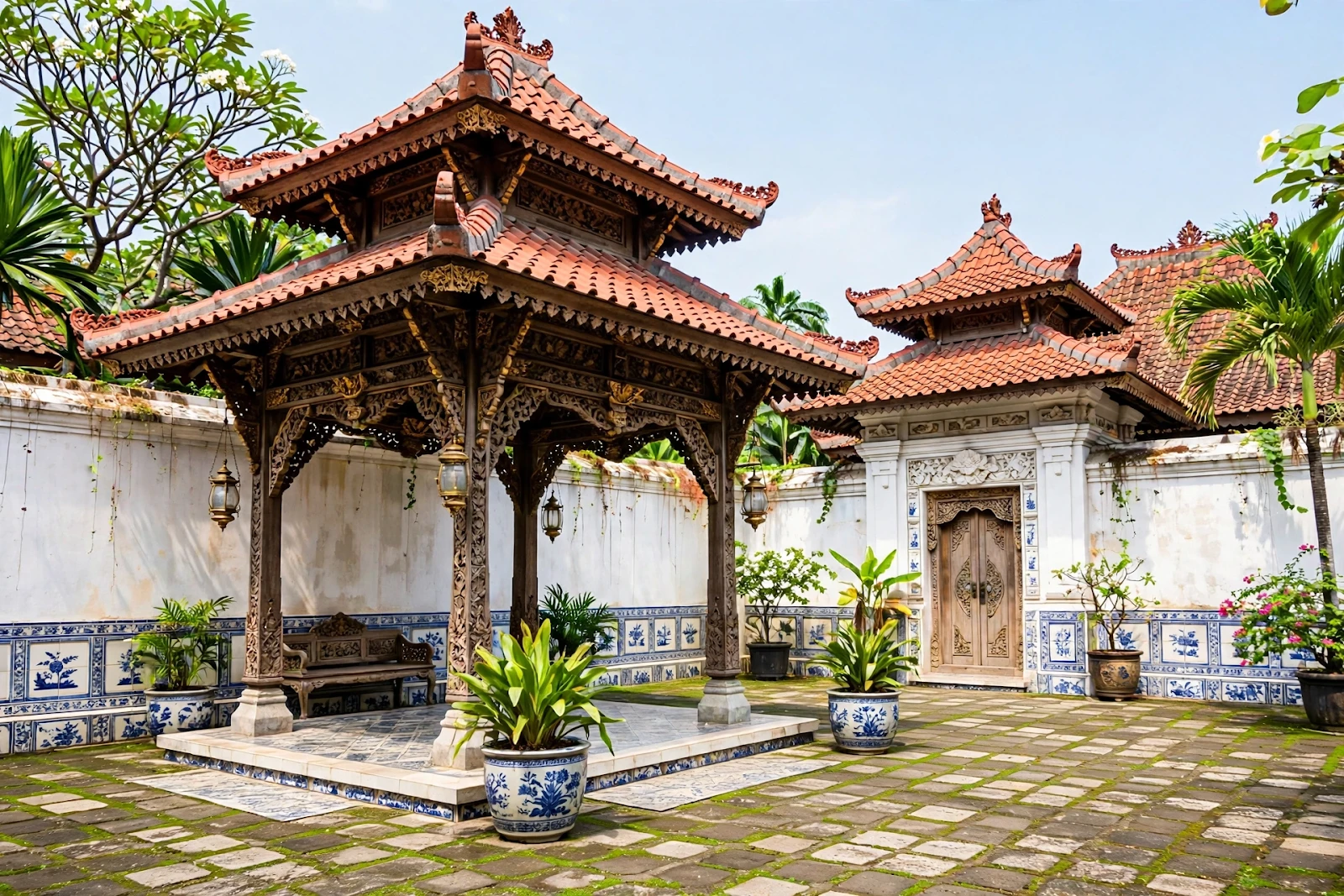
The natural starting point for any Cirebon visit is Keraton Kasepuhan, the oldest and grandest of the city's palaces. Founded in the 15th century and expanded over the following centuries, Kasepuhan is a fascinating blend of Javanese, Sundanese, Chinese, and European influences: whitewashed walls, carved wooden pavilions, red-tiled roofs, and decorative tiles and ceramics brought by trading ships. The palace complex includes a museum with royal carriages, weapons, and heirlooms, as well as pavilions where traditional performances are still held.
Ornate courtyard of Keraton Kasepuhan palace in Cirebon, West Java, with carved pavilion and white walls.
A short distance away stands Keraton Kanoman, the second palace, founded when the sultanate split in the late 17th century. Smaller and quieter than Kasepuhan, Kanoman has its own museum, its own distinctive architecture, and a more intimate atmosphere that many visitors prefer. Between the two palaces, the old town around them rewards a slow walk: narrow streets, old mosques including the Great Mosque of Sang Cipta Rasa with its distinctive tiered roof, and markets selling everything from spices to batik.
Practical details for the palaces: both are open daily, usually from morning until late afternoon, and a local guide is available at the entrance. Guides are worth hiring, as the stories behind the buildings, the royal carriages, and the sacred heirlooms bring the palaces to life in a way that signs alone cannot. Dress modestly, as parts of the complexes are sacred spaces, and allow two to three hours to see both palaces and the surrounding old town properly.
Keraton Visit Tips
Visit the palaces in the morning, when the light is best for photography and the courtyards are quietest. Some inner rooms may be closed during royal ceremonies or family events, so check at the entrance if there is something specific you want to see. Photography rules vary between rooms, so ask your guide before taking pictures inside the museum buildings. Finally, combine the palace visit with the nearby markets: the area around Kasepuhan is one of the best places in the city to shop for batik and local snacks.
Batik Trusmi Village
About 10 kilometres west of Cirebon city lies Trusmi, the village that has made Cirebon batik famous. Cirebon's batik is instantly recognisable: bold, bright, and full of motifs drawn from the sea and from Chinese-influenced cloud patterns, quite different from the more muted batik of Solo and Yogyakarta. The most famous motif is Mega Mendung, the stylised cloud pattern that has become a symbol of the city.
Artisan hand-painting batik patterns with a canting tool in Trusmi village near Cirebon, West Java.
Trusmi is a working village, not a showroom. Workshops line the main street, and in many of them you can watch artisans drawing wax patterns with a canting (a small copper pen), dyeing cloth in vats of colour, and hanging finished pieces to dry. Some workshops offer short batik-making sessions where you can try the canting yourself and take home a small piece you decorated. Even if you do not join a workshop, simply walking the street, watching the work, and chatting with the makers is one of the best cultural experiences in Cirebon.
Trusmi is also the best place to buy Cirebon batik. Shops range from small family stalls to large showrooms, and prices vary widely depending on whether the piece is hand-drawn (tulis), stamped (cap), or a combination. Hand-drawn batik takes weeks to make and costs more, but it is a genuine work of art. If you are buying, ask the seller to explain the motif and the technique: a good shop will be happy to show you the difference. Allow at least half a day for Trusmi, including the drive from the city, and bring cash for smaller workshops.
Seafood on Java's North Coast
Cirebon's position on the north coast means one thing above all: seafood. The city's harbour has landed fish, prawns, squid, and crabs for centuries, and the seafood restaurants along the coast and in the city centre are the place to taste the catch at its freshest. Grilled fish with sambal, prawns in sweet and spicy sauces, squid stir-fried with petai (stink beans) for the adventurous, and crab in rich sauces are all local staples.
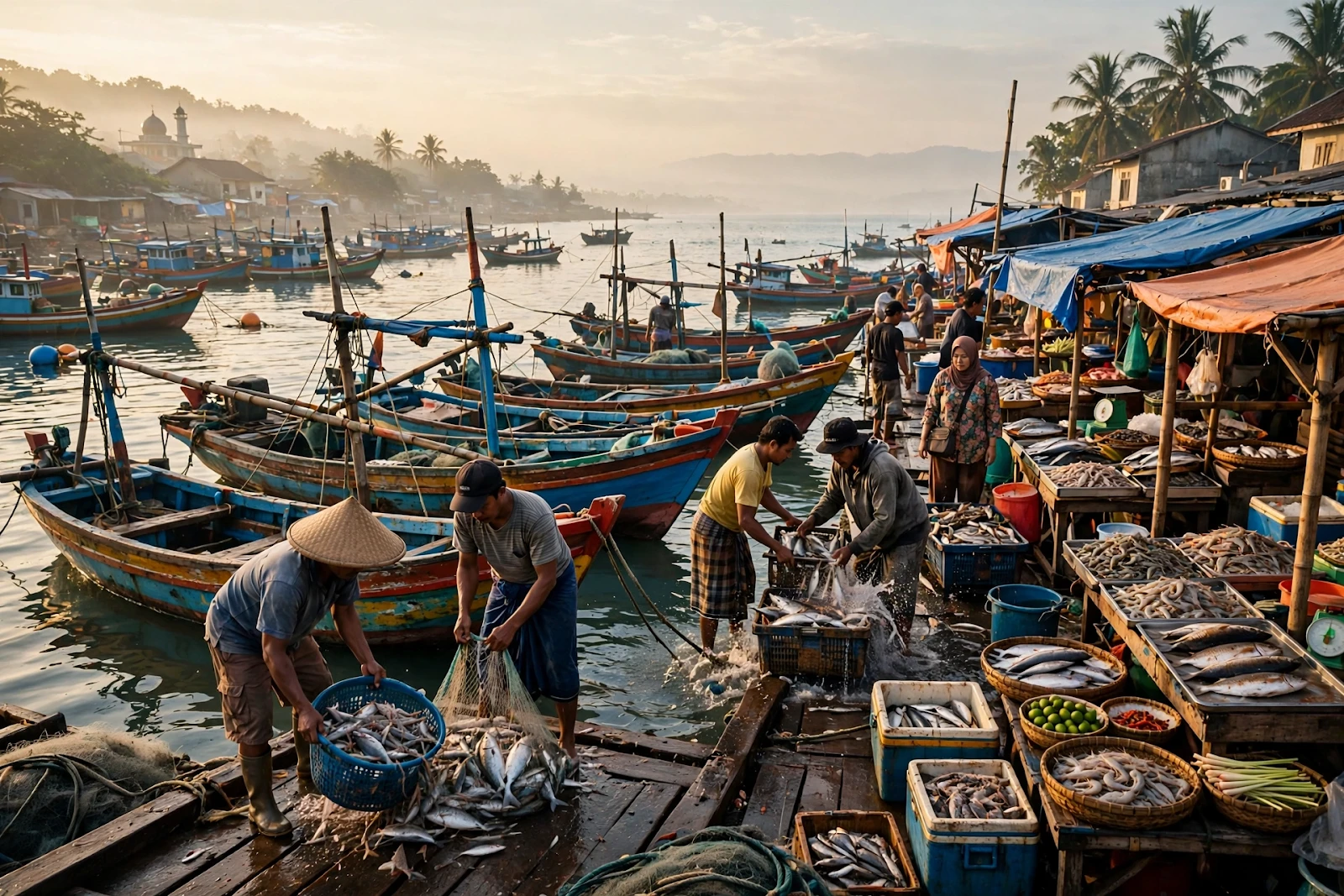
Colourful wooden fishing boats at a harbour in Cirebon on Java's north coast, with fishermen unloading the catch.
The best time to eat seafood in Cirebon is in the evening, when the restaurants fill with local families and the day's catch is on the menu. The harbour area itself is worth a visit in the late afternoon: colourful wooden boats bob at anchor, fishermen mend nets and unload crates, and the light over the Java Sea turns golden. It is a working harbour, so expect activity rather than polish, and bring a camera.
Beyond seafood, Cirebon's food scene has its own signatures. Empal gentong, a rich beef soup cooked in a clay pot with coconut milk and spices, is the city's most famous dish, and it pairs perfectly with lontong (rice cakes). Other local favourites include nasi jamblang, rice served on teak leaves with a spread of side dishes, and tahu gejrot, fried tofu in a sweet and spicy sauce sold by street vendors. The markets and food stalls around the old town are the best places to sample these, and a food-focused walk in the evening is one of the most enjoyable ways to spend a night in Cirebon.
How to Get to Cirebon from Jakarta and Bandung
Cirebon is one of the easiest cities in Java to reach. From Jakarta, the train is the best option: executive and business trains on the north coast line take around three hours to Cirebon station, with frequent departures throughout the day. The drive takes around three to four hours via the Cipali toll road, though weekend traffic can add to that time. From Bandung, the journey is around three to four hours by car or bus, passing through Sumedang and Majalengka.
Once you arrive, Cirebon city is compact and easy to get around. Becak (cycle rickshaws), angkot, and motorcycle taxis cover the distances between the station, the palaces, and the harbour, while a car with a driver is the most convenient option for a day trip to Trusmi and the surrounding villages. For international visitors, the simplest approach is to fly into Jakarta's Soekarno-Hatta Airport, take a train to Cirebon, and continue east by train toward Central Java afterwards: Cirebon sits neatly on the Jakarta to Yogyakarta and Semarang rail routes.
Best Time to Visit Cirebon
Cirebon can be visited year-round, but the dry season from May to September is generally the most comfortable, with less rain and clearer skies for walking the old town and visiting the harbour. The wet season from November to March brings heavier afternoon rain, though mornings are often still fine for sightseeing. Cirebon is a lowland coastal city, so temperatures are warm all year, usually in the low 30s Celsius during the day, and the humidity is high. Light clothing, sun protection, and plenty of water are essential.
Weekends and Indonesian public holidays are the busiest times, especially at the palaces and in Trusmi, so a weekday visit will give you quieter courtyards and more time with the batik artisans. If you can, time your visit to coincide with a traditional ceremony at one of the palaces, when the royal heritage of the city is on full display. Local tourism offices and your hotel can usually tell you what is happening during your stay.
Practical Tips for Visiting Cirebon
A few practical points will make your Cirebon trip smoother. First, carry cash: while hotels and larger restaurants accept cards, small workshops in Trusmi, market stalls, and street food vendors are often cash-only. Second, dress modestly for the palaces and mosques, and bring a sarong or scarf if you plan to enter prayer areas. Third, be prepared for limited English outside the main hotels. A few basic Indonesian phrases, or a translation app on your phone, will go a long way in markets and workshops.
Fourth, when buying batik, take your time and compare: ask whether a piece is tulis (hand-drawn), cap (stamped), or a combination, and check the quality of the cloth and the dye before paying. Fifth, respect local customs: Cirebon is a predominantly Muslim city with a strong royal and religious heritage, so ask before photographing people and ceremonies. Finally, give yourself more time than you think you need between sights: Cirebon's old town rewards slow walking, and the best discoveries are often the small workshops and food stalls you stumble upon.
Sample 2-Day Cirebon Itinerary
Day one starts with a morning train from Jakarta, arriving in Cirebon by late morning. Head straight to Keraton Kasepuhan with a guide, then walk to Keraton Kanoman and the Great Mosque, with lunch of empal gentong in the old town. In the afternoon, visit the harbour area for the fishing boats and the golden light, then enjoy a seafood dinner in the evening, followed by a food walk sampling tahu gejrot and other street snacks.
Day two is for Trusmi. Spend the morning in the batik village, watching the artisans, trying a short batik session, and shopping for pieces to take home. After lunch of nasi jamblang, return to the city for a final wander through the markets, then catch an afternoon or evening train onward to Yogyakarta or Semarang, or back to Jakarta. If you have a third day, use it for the nearby attractions: the Plangon monkey forest, the Sunyaragi cave park, or the shrimp ponds and fishing villages along the coast.
Sponsored: see today's best travel deals and offers
Frequently Asked Questions
How many days do I need in Cirebon?
Two days is enough to see the highlights: both Keraton palaces, the old town, Batik Trusmi village, and the harbour seafood scene, with time for local food and markets. Add one more day if you want to visit the nearby cave park, monkey forest, or coastal fishing villages.
Which Keraton palace should I visit first?
Start with Keraton Kasepuhan, the oldest and grandest palace, then visit Keraton Kanoman afterwards. The two are close together in the old town, and a guide at Kasepuhan can explain the history that connects them. Allow two to three hours for both palaces and the surrounding streets.
Is Cirebon batik different from Yogyakarta or Solo batik?
Yes. Cirebon batik is bolder and brighter, with motifs drawn from the sea and Chinese-influenced cloud patterns such as Mega Mendung. Yogyakarta and Solo batik tends to be more muted, with earthy browns and classical court patterns. Trusmi is the best place to see and buy authentic Cirebon batik.
Is Cirebon suitable for families with children?
Absolutely. The palaces, batik workshops, and harbour are all family-friendly, and children usually enjoy watching the batik makers and trying a short batik session in Trusmi. The city is compact, so distances between sights are short and easy to manage with kids.
Is Cirebon easy to reach without a car?
Yes, it is one of the easiest cities in Java to reach without a car. Frequent trains connect Jakarta with Cirebon in around three hours, and once there, becak, angkot, and motorcycle taxis cover the city. A car with a driver is only really needed for the trip out to Trusmi village.
Cirebon may not be the first name that comes to mind when planning a trip to Indonesia, but that is exactly why it is worth visiting. Between the royal palaces, the batik village, and the seafood of the north coast, this historic port city offers a complete cultural escape within easy reach of Jakarta. Plan your visit for the dry season, hire a guide at the palaces, and leave room in your itinerary for unhurried meals and market wandering. Have you visited Cirebon, or is it on your list for 2026? Share your plans, questions, and tips in the comments below — we would love to hear about your Cirebon adventure.




Comments
Post a Comment